For beachcombers, by beachcombers

Every piece has a story. Start hunting.

Seaglass Hunter helps you identify your finds, catalog your collection, and explore what hunters are discovering on beaches around the world.

Join the early collectors. Your finds stay yours.
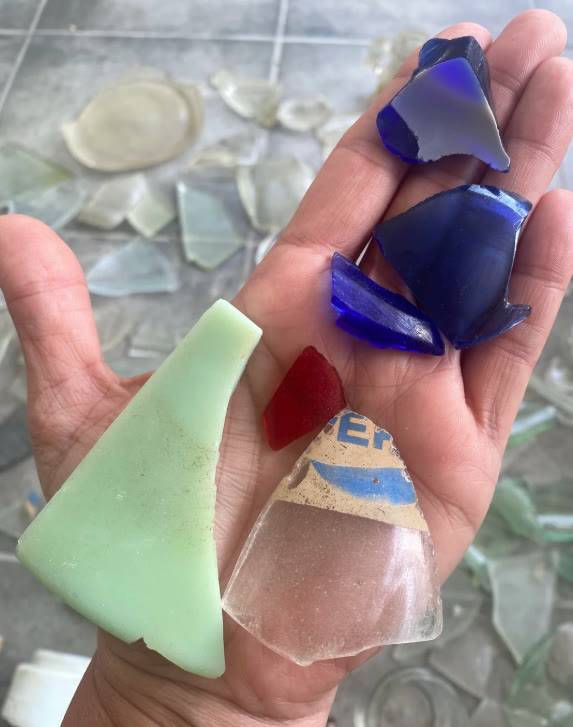
A hand holding a handful of sea glass finds in cobalt blue, seafoam green, red and frosted white.

A quiet place for the things you find

Tools that respect the slow, attentive pace of beachcombing.

Snap & identify

Upload a photo and our AI suggests what it is — sea glass color, likely era and possible bottle or object of origin — with reasoning you can double-check.

Your private library

Every find gets its own page with photos, location, notes, and tags. Browse, filter, and look back on a year of walks.

Share the wonder

Follow other beachcombers, comment on their finds, and ask the community for help with the tricky ones.

The field guide

The ultimate sea glass identification guide

From kelly green to cobalt to the elusive orange — learn what your finds are, where they came from, and how rare they really are.

Sea glass

Born of saltwater

Found on saltwater beaches. Alkaline, oxygen-rich seawater (pH 8+) leaches soda and lime from the glass in a process called hydration — leaving that signature frosty, pitted surface.

Beach glass

Tumbled by lakes & rivers

Freshwater shores. Less corrosive water means glass often keeps shiny spots, but rough wave action (think the Great Lakes) can still tumble pieces beautifully smooth over time.

Real or craft-tumbled fake?

The market is flooded with machine-tumbled glass. Two things give the genuine article away:

C-marks

Tiny "C"-shaped crescent micro-fissures from decades of impact with sand and pebbles. Impossible to fake in a rock tumbler.

Irregularity

Real sea glass varies in shape, thickness and texture. Fakes look too uniform, too perfectly round, and lack deep pitting.

Color rarity & origins

Common

The everyday finds

White / clear

Heavy frost, opaque. Modern soda bottles, food jars, windowpanes, tableware.

Kelly green

Mass-produced beer, wine and soda bottles from the 19th and 20th centuries.

Brown

Beer and bitters bottles. Workhorse of the beach.

Uncommon

Worth a second look

Seafoam green & aqua

Vintage Coca-Cola bottles, early-1900s mason jars, ink wells, electrical insulators.

Cobalt & cornflower blue

Medicine, poison and cosmetic jars — Vicks VapoRub, Noxzema, Bromo-Seltzer. The blue warned: don't drink.

Lavender

Clear glass made with manganese turns pale lavender after decades of UV sun exposure.

Rare

A great day at the beach

Pink

Depression-era tableware, or sun-purpled manganese glass that shifted toward rose.

Citron / yellow-green

Often Depression-era pressed glass and early uranium glass adjacent pieces.

Black ('pirate glass')

Looks like a pebble. Hold it to a strong light and you'll see deep olive or brown — liquor and ale bottles from the 1600s–1800s.

Extremely rare

The unicorns

Red

Pre-1950s tail lights, ship warning lanterns, Schlitz beer. Made with gold or copper.

Orange

Often called the rarest color. Cadmium and selenium — boat warning lights and art glass.

Yellow

True yellow (not citron) — vintage tableware and select art glass.

Turquoise

Electric hue from cobalt mixed with copper or iron. High-end art glass and ornate bottles.

True purple

Not the lavender of sun-purpled glass — a deep, intentional violet. Apothecary and art pieces.

Specialty & historic glass

🟩

Uranium / Vaseline glass

Made roughly 1880–1940, pale yellow-green by daylight. Trace uranium makes it glow neon green under a 365nm UV blacklight.

🎨

End-of-day glass (multis)

Multi-colored swirled pieces from glassblowers combining leftover colors at the end of a shift. Famously found in Seaham, England.

🟢

Glass fishing floats

Hollow teal, green or aqua orbs once supporting fishing nets in Norway, Japan and the US. Occasionally still wash ashore intact.

🔥

Bonfire glass

Melted in beach campfires or coastal dump fires before being swept back. Often bubbly with sand or small objects trapped inside.

🔮

Marbles

Children's toys or paint-can agitators ('clearies'). Highly prized once the surf has frosted them.

🥛

Milk glass

Opaque white, sometimes faintly translucent. Cold cream jars, vases and tableware — frosted milk glass is genuinely uncommon.

Grading the quality

Perfect
Jewelry grade

Completely smooth and frosty with no shiny spots anywhere. Ready to be set in silver.

Very fine
Excellent

Frosty with only one or two small 'nibbles' — tiny chips that don't disrupt the overall surface.

Fine
Strong

A few chips or small areas with a slight sheen where the frosting hasn't fully formed.

Very good
Re-tumbled

Areas that were chipped have since been re-frosted by the ocean — a sign of a long, slow second life.

Good
Honest

Smooth overall, but with noticeable chips. Still a beautiful keepsake.

Maker marks on the base

Found a piece with letters or a logo on the base? You may be holding a dateable shard. These are the most common manufacturer marks washed up on US beaches:

Owens-Illinois Glass Co.
Diamond-oval-I

Used 1929–1950s. The most frequently found maker mark on US beaches, mostly old soda bottles.

Maryland Glass Corp.
M inside a circle

1921–1970s. Frequent on cobalt-blue bottles — Bromo-Seltzer is the classic.

Owens Bottle Co.
O in a square

Predecessor of Owens-Illinois. Early 20th-century bottles.

Illinois Glass Co.
I inside a diamond

Early 1900s. Merged into Owens-Illinois in 1929.

Brockway Glass Co.
B inside a circle

Pennsylvania glassmaker, mid-20th century.

Anchor Hocking
Anchor entwined with H

Tableware and household glass from 1937 onward.

Obear-Nester Glass Co.
N in a square

Illinois bottle maker, early-to-mid 20th century.

Libbey Glass Co.
Cursive 'L'

Toledo-based tableware giant. Often on stemware and tumblers.

Saint-Gobain / Verallia
S G

European wine and spirits bottles — common on Atlantic and Mediterranean shores.

Pontil scar tip: a brownish or reddish residue ring on the base means hand-blown — pre-1860s. Names like Ball Perfect Mason and Kerr point to classic American fruit jars.

Keep it, or send it back

There's an old beachcombing wish: if a piece still has sharp edges, the water isn't finished with it yet, and it isn't meant for you. Some hunters only keep perfectly round, fully frosted pieces. Our rule is gentler: no sharp edges. If a find is smooth to the touch, it's yours to take home. If it still bites, say a good wish and toss it back to the ocean, lake or river. It will come back softer, someday, for someone.

A final tip for the field

Look at shapes, not just colors. Sea glass covered in dry white patina blends in with pebbles and shells — but unnatural geometry (squares, triangles, bottle-neck curves) gives it away every time.

Start your collection today

Claim your spot with the first wave of beachcombers. Lock in early-collector pricing.

Made with salty hands